Archive for the 'global/international' Category

Healthy Transitions for Adolescent Girls: working session at the CGI

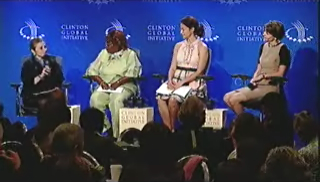
Panelists at the CGI Global Health working sessionYesterday I watched the live video feed of a Global Health working session at the Clinton Global Initiative Annual Meeting. (The press can’t attend the actual working sessions, so we had to sit and watch from the press room.) A bit of background - at the CGI Annual Meetings, government, corporate, and NGO leaders get together to discuss major world issues and figure out ways to tackle them. Each day they break out into working sessions, each one devoted to one of this year’s four focus areas: Poverty Alleviation, Energy and Climate Change, Education, and Global Health. This particular Global Health working session was entitled “Healthy Transitions for Adolescent Girls,” which immediately jumped out at me as a topic of great interest, both personally and for folks at Feministe.

Continue reading ‘Healthy Transitions for Adolescent Girls: working session at the CGI’

First day at the Clinton Global Initiative Annual Meeting

This morning I woke up far earlier than usual (6AM!) to get up to the 8am press meeting at the Clinton Global Initiative Annual Meeting. It’s been a really interesting, crazy time so far, starting from when I first arrived. When I came to Monday’s blogger meeting with Bill Clinton, I was surprised at how relaxed the security was for the meeting. Not so today. Getting into the Sheraton meant passing through the highest level of security I’ve ever experienced. This ranged from the no-tech to the highest of the high tech: manual bag search, walking through a sensor that detected the RFID inside of my press badge and instantly displayed my name and picture on a connected laptop, a metal detector, a handheld wand that could detect the RFID in my badge, AND some weird thing that seemed to take both normal pictures and x-ray type body scans. All to be expected given the number of world leaders, politicians, celebrities, and corporate leaders at the event, but still a bit unnerving. Past the doors, security has been pretty tight as well, with the press being carefully corralled and guided away from any mingling with the Important People.

I’ve spent most of my day in the press room with both bloggers and the more traditional media. These groups don’t mix that much. No matter, because it’s been fun to meet all of the other bloggers who are here and attach faces to names and the words they write. I do keep hoping that Amy Goodman or Juan Gonzalez will walk up into the press room, but I don’t think that’s too likely.

Panelists at the CGI Opening PlenaryDeanna and I liveblogged the Opening Plenary, which was chock full of celebrities, dignitaries, and noble ideas; check the record of the liveblogging for details. Afterwards, I attended the press conference with Lance Armstrong, where he announced the creation of the Livestrong Global Cancer Awareness Campaign as well as details his return to cycling, which he described as another way to raise international awareness of cancer: “While my intention is to train and compete as fiercely as I always have, this time I will gauge victory by how much progress woe make against cancer, a disease that will claim 8 million lives this year alone.”

Afterwards there was lunch (during which I was reminded that I like the idea of roast beef far more than I like the reality of roast beef), followed by the working sessions in which all of the bigwigs who are gathered here get down to business and try to come up with concrete ways to tackle issues of poverty, energy and climate change, education, and global health. I watched and listened to the live feed of the Global Health working session, the theme of which was “Healthy Transitions for Adolescent Girls.” The conversation and discussion that came afterward were fascinating, and I’ll be posting about it shortly. Then, a panel on philanthropy with Bill Clinton and Bill Gates (!), then home. Whew!

Cross-posted at Feministe

Meeting Bill Clinton

Me and Bill Clinton

(Note: details of the meeting follow my personal narrative!)

A couple of weeks ago I received an invitation to represent Feministe as a credentialed blogger at the Clinton Global Initiative Annual Meeting, which kicks off today in NYC. I was psyched, a tad skeptical, and more than a tad nervous all at once. I’ve never been invited to participate in anything as A Blogger, much less something this high-profile. I tend to think of myself as a relatively little fish in the blogosea, and all sorts of self-doubt about whether I was really qualified for this or deserved it started running through my head.

All of this anxiety was amped up exponentially when I got the additional invite to participate in a blogger meeting with President Bill Clinton before the start of the CGI meeting. I responded to the invite right away, but then all that doubt flooded in I nearly wrote back and said never mind. I mean, really - was I good enough or important enough to deserve a spot?

But then I thought to my self, now hold up, Jack. These doubts were certainly due in part to the sorts of insecurities that everyone gets from time to time about their skills, and also due in part to some rational acknowledgment of the fact that, for sure, I haven’t busted ass posting or networking or engaging in the public discourse as much as some other folks out there, so I’m understandably gonna be smaller potatoes. But I think they were also fueled in no small part by internalization of the sort of dynamics that permeate the blogosphere as much as the rest of the world; dynamics of privilege and power that automatically lend higher degrees of traction, legitimacy, or “authority” (as Technocrati puts it) to certain voices than to others for reasons entirely apart from the quality and quantity of their thoughts and words. The kind of dynamics, for example, that led to a 2006 blogger meeting with Bill Clinton being all white (and that helped this year’s meeting be predominantly white, too.) [1] Internalization is all about oppressed people learning to help keep themselves down, so I checked myself and decided not to help out on that count.

There was also an entirely different set of misgivings: how would I reconcile my politics with this meeting? Continue reading ‘Meeting Bill Clinton’

The execution of Jose Ernesto Medellin: another American middle finger raised at international law

Recently I decided to read the work of Noam Chomsky for the first time, beginning with Hegemony or Survival. I’m a few chapters in now, and one of the points that Chomsky makes is that the United States continues to show blatant disregard and even contempt for international law and institutions such as the United Nations. Chomsky focuses on the start of the war in Iraq in defiance of the Security Council and the UN in general as one of the United States’ most stark dismissals of international law, but also details similar dismissals with regards to other military engagements. He asserts that this is part and parcel of larger project of the United States, which reserves “the right to resort to force to eliminate any perceived challenge to US global hegemony, which is to be permanent.”

For people paying attention, the US’ disregard for international law - as shown through its preemptive strikes, its dismissals of the Geneva Conventions with regards to torture, its secret renditions, and its snubbing of a litany of treaties and agreements - has been worrisome for a long time. As Chomsky asserts, “when the UN fails to serve as ‘an instrument of American unilateralism’ … it is dismissed.” Essentially, the government of the United States believes that it can do whatever the hell it wants, with a big middle finger raised towards any other nation or international organization that calls it on its murderous, imperialistic bullshit. Or, as John Bolton, our illustrious former UN ambassador, put it: “There is no such thing as the United Nations. There is only the international community, which can only be led by the only remaining superpower, which is the United States.”

So when I read this morning about the Texas execution of a Mexican citizen convicted of murder, the story fit right into the larger pattern of the United States’ perception of itself as supreme. Jose Ernesto Medellin, convicted of the 1993 rape and murder of two teenage girls, was executed Tuesday night despite an order from the International Court of Justice at the Hague to halt the executions of Mexican citizens on Texas’ death row. From the LA Times article:

The International Court of Justice in The Hague sided in 2004 with the Mexican government’s argument that the United States had violated the 1963 Vienna Convention on Consular Relations by failing to inform the arrested Mexican nationals of their right to seek help from the Mexican Consulate.

Mexico has asked that all 51 convictions be reviewed, creating the possibility for new trials or outright dismissals. The Hague court had ordered the United States not to execute any of five men on death row in Texas while the court reviewed their cases.

But the court, a branch of the United Nations, has no power to enforce its rulings. A spokesman for Texas Gov. Rick Perry, a Republican, has said that “the world court has no standing in Texas.”

Emphasis added, because the statement so clearly crystallizes not only the attitude of the state of Texas, but of the United States as a whole. Surprisingly enough, the Bush administration attempted to intervene and halt the executions: “Mr Bush wrote a two-paragraph memorandum to the Department of Justice saying Texas courts must obey the ICJ ruling and review Mr Medellín’s conviction and sentence to determine whether his rights were violated because he was not allowed to contact his consulate.” However, as the LA Times reports, “the U.S. Supreme Court rejected the administration’s arguments, ruling 6-3 that under the Constitution, the president did not have the ‘unilateral authority’ to compel state officials to comply with an international treaty.”

Interesting. So the President seems to have unilateral authority to do all sorts of awful things, but not when it comes to enforcing international law? I suppose this makes sense, though; after all, why should individual states not follow the example of the larger nation in its utter disregard for the rule of international law? In these executions, Texas is only applying the precedent that the US government has demonstrated time and time again: the United States can do what it wants, and fuck the rest of the world if they complain.

The LA Times reports that “Human Rights Watch and Amnesty International contend that executing foreign citizens in opposition to the court order could put U.S. citizens abroad at risk of being convicted and even executed for crimes without having access to U.S. consulates or embassies.” Jeffrey Davidow, former U.S. Ambassador to Mexico, expands upon that:

So we now find ourselves on the brink of an irrevocable violation of the most important treaty governing consular assistance for our citizens detained in other countries. A failure to comply with this most basic of treaty commitments would significantly impair the ability of our diplomats and leaders to protect the interests — individual and collective — of Americans abroad. Were the tables turned — American citizens arrested abroad and denied consular access, with an ICJ judgment requiring review of those cases for prejudice, and another nation refusing to comply — our leaders would rightly demand that compliance be forthcoming.

Unfortunately, as the United States continues to flout international law, other nations might not be so interested in extending favor to us that they do not get from us. And why should they? Why should other nations not be allowed to exercise their sovereignty just as the United States does? Oh, that’s right: it’s because the people in power in this nation believe in the Rule of Might over the Rule of Law, and the United States just happens to have the biggest guns.

The Story of Stuff

Cross-posted at Feministe

Every morning I seem to find some distraction on the Internet that leads to me running out the door far later than I should have left or starting my work day woefully off schedule. Usually the distraction is something like Scramble on Facebook, but this morning’s distraction was enriching and enlightening enough that I don’t feel so bad about running late (and running even later in order to share it with you folks.) A friend of mine (thanks, Eli!) linked to The Story of Stuff, a short documentary on the insidious processes that go into consumption as we know it. The video has been online since December 2007 and has apparently had 2 million viewers so I risk recommending it to a bunch of folks who’ve already seen it, but I hadn’t and I thought it important to share.

Annie Leonard, a scholar who has done many years of research on consumerism, development, sustainability, and environmental health, guides us through the linear process that drives the material economy - extraction, production, distribution, consumption, and disposal - exposing the many moments in the process that are often left out of the big picture but which are often most telling of the damage occurs within each of these steps. I’ve seen and read many things about consumption and its effects on our world, but this movie broke things down in a clearer, more complete and more urgent way than I’ve seen before. Leonard does a good job of bringing to light the environmental, health, labor, globalization and other social justice problems inherent to the system of consumption.

Some of the facts that Leonard cites are truly frightening. One fact that I’d never heard before and found particularly shocking: when talking about the countless toxic chemicals used in production and therefore brought into our homes and our bodies, Leonard says:

Do you know what is the food at the top of the food chain with the highest levels of many toxic contaminants? Human breast milk. That means that we’ve reached a point where the smallest members of our societies - our babies - are getting the highest lifetime dose of toxic chemicals from breast feeding from their mothers. Is that not an incredible violation?

I appreciated that Leonard called this a “violation,” because that’s precisely what it is. We have allowed corporations and complicit governments to violate our very bodies, as well as our environment and countless cultures and communities, simply in order to give us cheaper, more consumable products.* Leonard thankfully goes on to stress that “breast feeding is still best,” but as someone who plans to probably give birth and subsequently breast feed, that fact about the toxicity of breast milk is frightening and enraging. It really does feel like a violation - corporations and the government have allowed this shit to get into me.

Of course, there’s a large degree of agency here - we, primarily meaning Americans and other westerners, have a tremendous responsibility to reject the system of capitalism and consumption that got us into this mess. We need to wake up to the realities of what cheap, easy, and disposable all really mean in the long run - as Leonard says, someone, or more accurately many someones, are paying the real price for all of that cheap crap that many of us in the U.S. can buy easily thanks to our huge privilege relative to the rest of the world. Sometimes the people paying the price are far away and look nothing like (some of) us, but sometimes, as with toxic breast milk, we’re also paying directly and dearly. And whether we pay or someone else pays the immediate and direct costs, when it comes to the destruction of the earth, we’re all most definitely going to pay up sooner rather than later. And therefore we who live in the countries that use and abuse and benefit from the system of consumption the most have an urgent responsibility to do something about it.

Unfortunately, that responsibility and our agency to act on it are both so limited by our lack of information. The true costs of American-style production and consumption were never covered in my schooling, nor are they something that make it into the mainstream media with any depth or sufficiency. It’s easy to go through life just not knowing or even questioning how our actions and our consumption are part of a much larger system with far-reaching effects, and the profiteering corporations are more than happy to keep it that way. In such a dearth of information and truth, resources like this movie are vital and can go a long way towards providing the knowledge people need in order to understand what this culture of consumption is doing to them as individuals, to their communities, to other people, and to the environment.

Of course, it’s hard to figure out what the hell to do after looking at a video like that. I appreciate that the Story of Stuff site provides “10 Little and Big Things You Can Do”, along with a resources page that includes recommended reading and links to NGOs working on these issues.

* Note that for the most part this doesn’t mean “better” products in terms of durability and sustainability; Leonard also states that only 1% of consumer products are still actually in use just six months from the date of purchase, which boggles the mind.

Farewell, Fidel


Fatal error: Allowed memory size of 16777216 bytes exhausted (tried to allocate 40961 bytes) in /home/members/palantetech/sites/angrybrownbutch.com/web/wp-content/plugins/ultimate_ga.php on line 201
l*?l*(l*`Ol*hl*l*ownbutchYXal*vl*l*l*m_pages'Ybl*pwl*l*hl*' => falYc0l*xl*pl*l*uthors' Y`dl*xl*l*l*rack_filYel*hyl* l*pl*f,jpg,jpYf8l*zl*xl*l*il_linksYhgl*l*l* l*ates' =>Yhl*`l*(l*xl*